
The Patriarch Household Producer
The career man builds nothing. The patriarch builds an estate.

What Is a Patriarch Household Producer
Picture the modern father. He wakes at six. He kisses his sleeping kids. He drives an hour into the city, sits in an office under fluorescent lights, answers emails for a man he’ll never meet. Drives home. Eats dinner. Watches an hour of his children’s lives before they go to bed. Repeats this for forty years. At the end he retires, sells his house at a loss adjusted for inflation, lives off whatever the 401k has left after the market took its cut, and dies. His sons inherit a Honda Civic and some cash. His daughters get the same. His wife gets the rest.
Now ask the question that no one asks. What did he build? What did he hand down? What did his sons learn from him about being a man? When his grandsons grow up and try to remember him, what will they have? A photo on a wall. A funny story about how he liked his coffee. Maybe a wristwatch.
This is the life most Catholic men in America are living right now. They were told it was the responsible path. They were told it was sacrifice. They were told it was provision. It is not. It is the opposite of all those things. It is the path that hollowed out the Catholic family, and it is the path that keeps hollowing it.
I want to introduce a different archetype. I’m going to call him the patriarch household producer. He is not a new invention. He is the recovery of the oldest pattern of Christian fatherhood, and we have forgotten what he looks like.
The career is the anomaly, not the norm
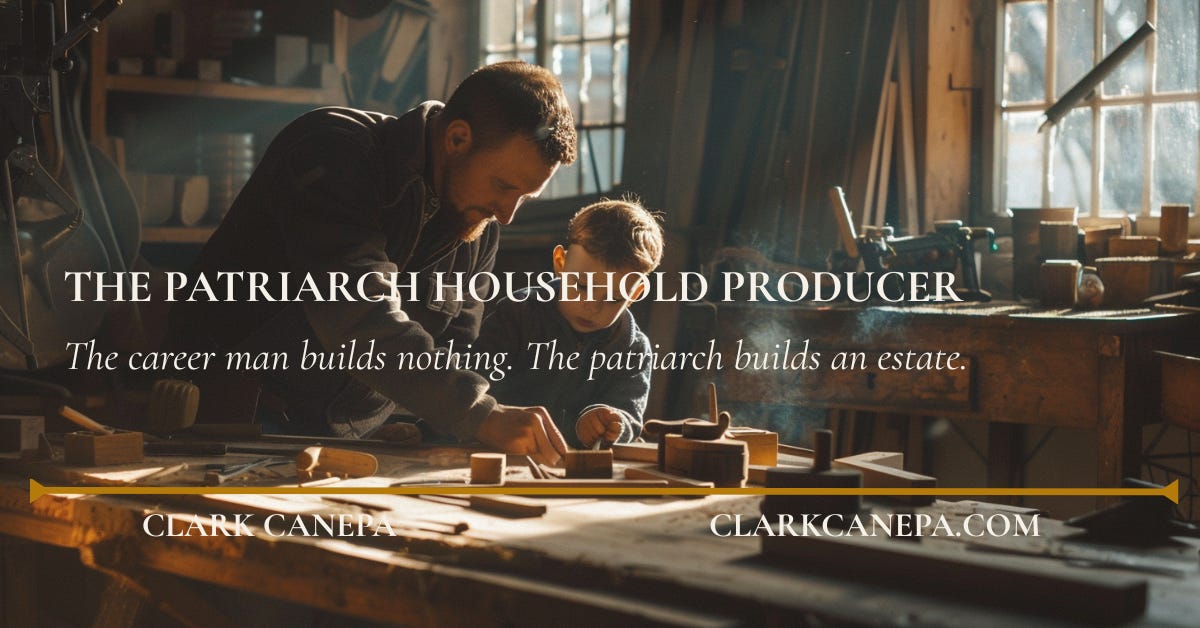
Men have not always lived this way. The pattern of the father who leaves home before the family wakes and returns after the children have eaten is a recent invention. For most of human history, including most of Christian history, fathers worked at home or in view of their sons. They were farmers, craftsmen, tradesmen, shopkeepers, smiths. The boy grew up watching the father work. He learned the trade by being there. By twelve he was useful. By sixteen he was capable. By twenty he was a man, ready to take a wife and begin his own household.
The corporate career, where a father disappears for ten hours a day into a building his children have never entered, doing work they cannot describe, for a company they have no relationship to, is a 20th century artifact. It is not the way men have lived. It is the way men were made to live by an industrial economy that needed interchangeable wage laborers and was happy to dissolve the household to get them.
Most men reading this think of the corporate career as the default and any alternative as a fringe lifestyle. It is the other way around. The career is the deviation. The household production model is the inheritance.
What the patriarchs actually were
The word patriarch has been worn down in the last fifty years until it means something it does not mean. When the modern reader hears patriarch, half of them think of an Old Testament figure with a long beard, and the other half think of a political abstraction invented by sociologists to describe everything wrong with men. Neither is what I’m talking about.
The patriarch in the Catholic and biblical sense is Abraham. Isaac. Jacob. Joseph in his workshop with the boy Christ at his side. The head of a household that included wife, children, servants, livestock, land, and the worship of God. The patriarch was not a manager and not a tyrant. He was a father in the full sense. He produced. He blessed. He handed down. His authority was real because his responsibility was real.
The Catholic tradition has never been embarrassed about this. Aquinas writes about the household economy as the smallest unit of human flourishing, ordered under the father as its head. Leo XIII in Rerum Novarum defends the family wage and the integrity of the household against the industrial economy that was already in 1891 starting to dissolve it. Familiaris Consortio under John Paul II reaffirms the father’s irreplaceable role in the formation of his children, particularly his sons.
This is not fringe Catholic teaching. It is the mainstream of the tradition. We have just forgotten it.
The household producer
Here is the archetype.
The patriarch household producer is a man who produces real goods or services from his household. His work and his fatherhood are the same activity. His sons grow up alongside him in the work, learning by doing, becoming capable in real things by the time they are young men. His wife is at home, ordering the household, raising the youngest children, producing in her own way, not subject to a wage employer. His daughters grow up in the house, learning what a Christian household looks like from the inside, preparing to run their own one day. His land or his shop or his trade or his business is the asset he is building, and it is transmissible. When he dies, his sons step into something that already exists. They do not start from zero.
He may be a farmer. He may be a craftsman. He may be a small business owner. He may be a tradesman who runs his own shop. He may, in the modern variant, be a man who runs an online business or a creative studio from his home, with his sons working at his side as they grow into it. The form varies. The substance is the same. He produces from the household, with the household, for the household.
This is not homesteading as a hobby. This is not a tradwife performance. This is not a romantic retreat from modernity. This is an economic structure. It is the structure that built every Christian civilization that ever existed, and it is the structure the modern West has dismantled in two generations.
The double inheritance
The career man, at the end of his life, hands down two things. A modest financial sum, divided among his children, that will not change any of their lives. And a lifetime of weak example, because his children watched him serve a company they could not see and produce a salary they could not touch.
The patriarch household producer hands down two different things. He hands down sons who are capable. They know how to work. They know how to build. They know what their father did because they did it with him. They have skills. They have judgment. They have masculine confidence that comes from twenty years of real responsibility, not from a self help book.
And he hands down an actual asset. Land. A business. A trade. A workshop. Tools. Customers. Knowledge. Relationships. Something that survives him and that his sons can step into and build on. The biblical phrase is “a good man leaves an inheritance to his children’s children.” The career man cannot do this. He has nothing to hand down two generations because he never built anything in the first place. He earned a salary and spent it on a depreciating house and a depreciating car.
The household producer is doing something the career man cannot do. He is building something that lasts.
Sons learn to be men by working with their fathers
There is a separate argument here that needs to be named directly. The career model does not just fail economically. It fails at the formation of sons.
Boys become men by working alongside men in real work. They cannot become men any other way. They cannot become men in classrooms run mostly by women. They cannot become men through screens. They cannot become men in peer groups of other unformed boys. They cannot become men in an hour a day with a tired father who has nothing left to give after his commute. They certainly cannot become men by watching hedonistic misogynists talk about the importance of his Bugatti color choice.
The career model takes the boy and hands him to the school for eight hours, the screen for four, and the peer group for the rest. The father sees his son in fragments. The boy grows up shaped by his teachers, his algorithms, and his friends, all of whom have less interest in his soul than his father does.
This is not how men are made. Every traditional culture knew this. Every traditional culture had the father pulling the son into the work as soon as the son was old enough to be useful. By twelve the boy was contributing. By sixteen he was nearly a man. By twenty he was ready.
The modern Catholic father, gone for ten hours a day, has outsourced the formation of his sons to institutions that do not love them. Then he wonders why his sons reach twenty five and cannot do anything, cannot commit to anything, cannot lead anything. They were never formed. They were processed.
The wife in the household
A man’s wife should not have a boss other than him. This needs to be said plainly because most modern Catholic men have lost the ability to say it.
I do not mean this in the workplace-management sense. The husband is not his wife’s manager. The husband is the head of the household in the scriptural sense, the one Paul gives in Ephesians 5: “husbands love your wives as Christ loved the Church and gave himself up for her.” Headship is sacrificial. It is responsibility before it is authority. The husband’s headship is real, and it is also the headship of a man who would die for his wife, not the headship of a foreman.
But headship is real, and a wife who is subject to a workplace hierarchy outside her household has another head. She has a manager who tells her when to come, when to leave, what to wear, what to say in meetings, what to think about the company’s politics. She is, for forty hours a week, taking orders from another man. This is not a small thing. It is a structural disordering of the household that scripture takes for granted should not exist.
Most Catholic men justify this arrangement by saying they cannot afford for their wives to be at home. This is a cope, and we should be honest about it. Most of these men are driving a new car. Most of these men have a mortgage on a house that was beyond their actual means. Their lifestyle requires two incomes because they chose a lifestyle that requires two incomes. They did not have to choose it. They could have bought the smaller house, kept the older car, accepted the lower standard of consumption, and kept the wife at home. They chose otherwise.
The deeper failure underneath the financial one is a failure of authority. Many of these men do not know how to be the head of their household. They were not raised by patriarchs. They were raised by career men. They have no model for what it looks like to order a household under their headship, and so they default to a partnership of equals, both working, both reporting to outside bosses, both exhausted, both wondering why the marriage feels like a logistics meeting.
The wife at home is not idle. The Proverbs 31 woman is not idle. Read the chapter. She buys fields. She plants vineyards. She makes garments and sells them. She runs a household economy that is itself productive. She is an entrepreneur whose enterprise is the household. This is not the modern feminist caricature of the housewife as a bored consumer. This is a woman whose work is real, who produces real things, and whose production strengthens the household rather than serving an outside corporation.
I will say something personal here. If I were single, I could not run a household. I have tried. It is too much. I would barely be able to maintain a small monk’s cell. The work that wives do, the ordering of a home, the love that fills a house, the management of children and meals and rhythms and feasts and the thousand things that make a household a home rather than a building, is invaluable and largely invisible to the men who benefit from it. A wife at home, free to do this work in her safe feminine place rather than commuting to call another man boss, is one of the great assets a man can have. The modern career model has stripped most Catholic men of this asset and convinced them they are better off for it.
Daughters and the dowry
The Christian tradition handed down to daughters in a different way than it handed down to sons. The biblical and traditional pattern was the dowry, given to the daughter at her marriage, which gave her something of her own as she entered her husband’s household.
The dowry has nearly disappeared from Christian practice. This is a loss. The dowry is the opposite of the practice in many other religions and cultures historically, where daughters were sold to the highest bidder and the bride price went to the father. In the Christian dowry, the father gives, not receives. He sends his daughter into marriage with something. He empowers her. And he does so in a way that gives him real involvement in the question of whom she marries, because the dowry is conditional. It is given to a husband the father has approved.
The dowry protects the daughter. A man who will receive a dowry is a man who has been weighed by a father and found acceptable. He has skin in the game. He is not a boyfriend. He is a man entering into a covenant that another man has confirmed.
The dowry strengthens the marriage. The daughter enters her new household with an asset, not empty handed. She is not a dependent at the start of her marriage. She has been given something.
The dowry strengthens the father. He is not a sentimental observer at his daughter’s wedding. He is a participant in her life’s most important transition. He has the standing of a man who provides, even at the moment he is letting his daughter go.
Catholic men should think seriously about reviving this. Not as a quaint custom but as a real practice. Save for it. Plan for it. Tell your daughters from the time they are young that they will have a dowry, and that the dowry will be given to a husband you have approved. Tell them what kind of husband that is. Form them to want such a husband. The recovery of the dowry is one of the practical recoveries that turns the household producer model from theory into a tradition that actually transmits.
The honest difficulty
I am not pretending this is easy. Most men reading this are stuck in careers because of debt, mortgages, school loans, a wife already working, kids already in school, the whole modern apparatus that has been built around the assumption that both spouses work and the household produces nothing.
You may not be able to walk into your boss’s office tomorrow and quit. You may not be able to buy land next month. Your wife may not be able to leave her job this year. The system does not allow most men to flip a switch.
What it does allow is direction. You can move toward this, even if you cannot leap to it. You can stop buying the new car and start saving for land. You can start a side business that has a chance of becoming the main one. You can take your sons into whatever work you actually do, even if it is not ideal, and start forming them in real responsibility now. You can begin to tell your daughters about the dowry you intend to give them. You can sit with your wife and ask whether the lifestyle that requires her income is worth the price you are both paying.
The recovery is generational. It does not happen in a year. It happens when one Catholic man decides his sons will not live the life he is living, and he begins, however imperfectly, to build something different.
The call
We were told the corporate career was the responsible path. It was sold to us as provision and sacrifice. It is neither. It is a structure that consumes the father, isolates the wife, deforms the sons, and leaves the daughters at the mercy of a marriage market full of men who were also formed by it.
The patriarch household producer is the recovery of an older pattern. A father who produces, with his sons at his side, with his wife free to keep the household, with his daughters formed to enter Christian marriages with dowries he has provided. A man who builds something that survives him and that his children’s children will inherit. A man whose home is not just where he sleeps but where he works, where he leads, where he prays, where he hands down the faith and the trade and the name.
This is not a fantasy but what Catholic men used to be. This is what some Catholic men still are, in pockets, where the old order has held. This is what more of us could become if we decided that our sons deserve fathers and our daughters deserve patriarchs and our wives deserve husbands who know how to lead their households.
The career man builds nothing and hands down nothing. The patriarch household producer builds an estate, in the fullest sense of the word. Land. Family. Faith. Trade. Inheritance. A name his grandsons will speak with weight.
Choose which one you intend to be. Then start, today, building toward it.