
Why Church Buildings Matter More Than People Want to Admit
A defense of the long-criticized opulent Catholic Churches

There is a reason why historically Catholic churches are large, beautiful, and materially rich. This is not an accident, and it is not aesthetic excess. It is theological instruction made visible.
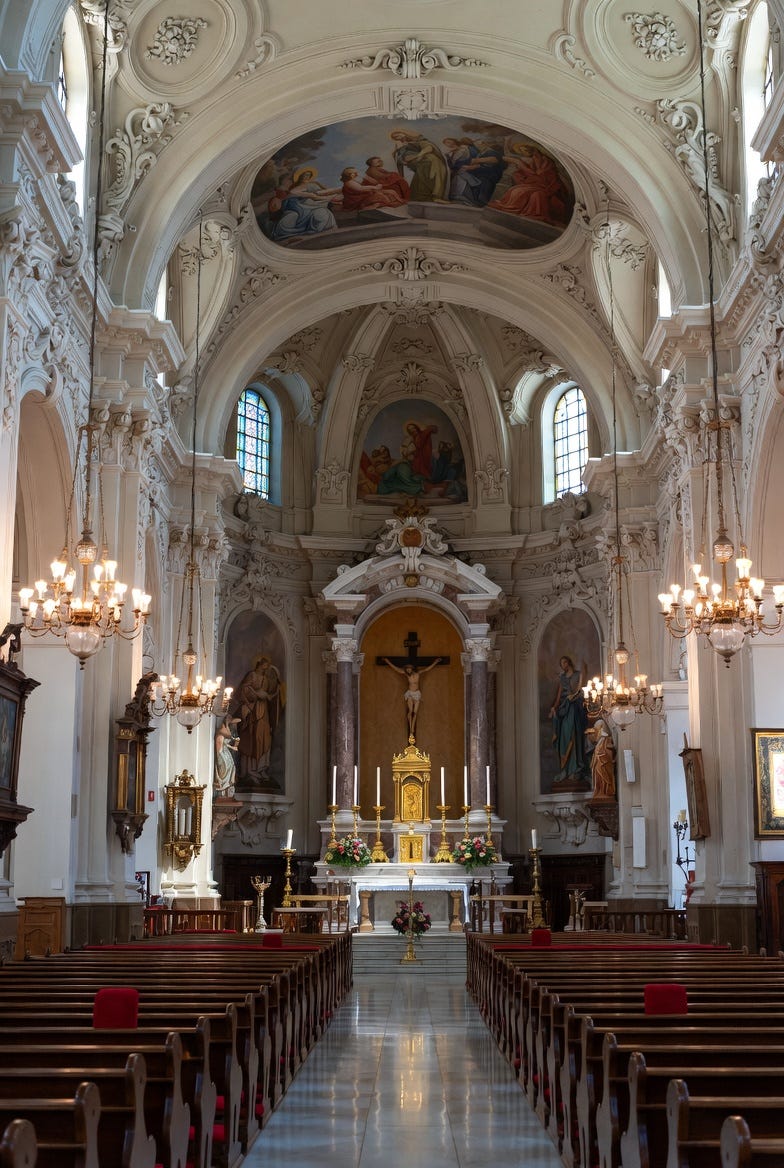
The building matters because it teaches the believer what is important before a single word is spoken.
A sacred church building de-emphasizes the importance of personal wealth. When the most materially beautiful and valuable place a believer regularly enters is not his home, his office, or his possessions, but the house of God, a hierarchy of value is established. What is highest is not owned privately. It is shared.
In this sense, the Church becomes the richest thing the poorest man has access to.
A laborer with very little to his name can enter a cathedral or basilica and stand inside something far more magnificent than anything a wealthy man owns privately. The splendor does not belong to an elite class. It belongs to the Church. And by extension, it belongs to every believer equally.
This has a leveling effect that modern people often miss. Sacred wealth humbles the rich rather than elevating them. A wealthy parishioner does not walk into Mass and feel superior because of what he owns. He is confronted with something greater than himself, something he does not possess, and something he cannot buy his way into.
The Church’s visible power and beauty relativize individual status.
This is why small and humble parishes still participate in the same logic. Even if a local church is modest, Catholics know that the great basilicas and cathedrals of their region are theirs. They belong to the same Church. The inheritance is shared. The highest material beauty available is not locked behind private gates.
This communicates something subtle but essential. Your personal wealth is not the highest good. The Church is.
Only after this is understood does the contrast with modern Protestant architecture become clear.
Many Protestant churches are intentionally utilitarian. Strip malls, warehouses, plain auditoriums. The stated reasoning is often humility or efficiency. But architecture always teaches something, whether intended or not.
When sacred space is materially indistinguishable from commercial space, the hierarchy reverses. The church building no longer stands above private wealth. It sits below it. Wealthy members often have access to homes, clubs, and private spaces that are more beautiful and more impressive than the place of worship itself. Poorer members do not.
This fractures the shared inheritance of believers. Sacred space no longer equalizes. It mirrors economic stratification instead of correcting it.
The issue is not simplicity versus extravagance. It is what is allowed to be the highest visible good. In Catholicism, the Church is meant to occupy that place. Not because God needs gold or stone, but because man needs to see, physically, that God outranks everything else he values.
Architecture catechizes. It always has.
A Church that is visibly greater than the individual teaches humility, equality, and transcendence without saying a word. A Church that is materially smaller than the private lives of its wealthiest members teaches the opposite, even if unintentionally.
This is why buildings matter. They form souls long before sermons do.